
I Sing the City Electric: Modern Singapore Envisioned in Popular Malay Music
By Faris Joraimi
In the 1961 film Seniman Bujang Lapok, starring Malayan impresario P. Ramlee, the viewer is treated to opening shots that follow the path of a lorry as it wends its way through Singapore town. The camera pans to automobiles plying the Anderson Bridge, and the opulent Fullerton Hotel on the opposite bank of the Singapore River. The sequence that follows is a visual laundry-list of the city’s landmarks: the Victoria Concert Hall with its soaring clocktower, more motorcars, grand Connaught Drive, the Padang, the neoclassical columns of City Hall, the legendary Capitol Theatre on Stamford Road (boasting of the latest film shot “In Technicolor!”) and the Lido on Orchard Road.

The Capitol Theatre between Stamford Road and Hill Street in the 1950s. Built in the Neoclassical style, it opened in 1930 and was regarded as one of Singapore’s finest cinemas.
Source: National Archives of Singapore
Seniman Bujang Lapok was shot and produced in Singapore by Shaw Brothers, which later went on to become Hong Kong’s largest cinematic conglomerate. The film is a self-referential commentary on commercial entertainment and its mechanisms of production. It also celebrates the city. Seniman was made in a time when Singapore - although a predominantly Chinese city - was also the undisputed capital of Malay pop culture. Over the span of about three decades after the second world war, Singapore’s Malay stars recorded and released hundreds of popular songs. Some of which illustrated what the city was like in the years before independence.
One from the 1940s, Uncle Murtabak by M. Yatim, contains interesting mentions from the perspective of a working-class resident. People shopped at Robinsen Petang (“evening Robinson’s”), a flea market colloquially named after Robinson’s Department Store at Raffles Place. The titular Uncle takes a bone-rattling trolley-bus (naik trolley bas berjongkit-jongkit) across town. These are images foreign to Singaporeans today. But they should come as no surprise. By the 1930s, Singapore was one of the richest cities in Asia. It had glittering department stores, an opulent waterfront of hotels, banks and trading houses, and the largest trolley-bus system in the world [i]. It was also - as the song demonstrates - very unequal.

Long before Singapore’s skyline was dominated by the iconic Marina Bay Sands, there was Collyer Quay: an elegant waterfront promenade that offered unobstructed views of the sea. It was lined with opulent buildings like the Fullerton Hotel and the Alkaff Arcade. A trolley-bus can be seen turning at a bend.
Source: National Archives of Singapore
Being a colonial emporium, Singapore’s wealth was largely held by a European elite. Asians largely formed Singapore’s working underclass. The Malays, who are also the indigenous inhabitants of Singapore and its surrounding maritime region, are stereotypically associated with poverty and rural habitation. Indeed, urban historian Imran Tajudeen notes how the two typological features of Singapore’s colonial cityscape — the wooden kampong house and the stone shophouse — occupy a racialised binary [ii]. The former is “exclusively Malay and therefore rural”, while the shophouse is “urban and thereby naturally Chinese” [iii]. However, there were some who participated in trade and were able to attain no small degree of affluence. Imran finds that the Malay merchants and aristocrats of Singapore too lived in ornate townhouses. These were concentrated in Kampong Gelam, a once-sprawling urban ward located immediately east of the international port around the Singapore River estuary.
The world of Kampong Gelam - which is today a gazetted historic district - was one of booming commerce and cosmopolitan cultural exchanges. The playback singer Momo Latiff encapsulated this atmosphere in her song, Singapura di Kampong Jawa. Kampong Jawa (Arab Street today) was an important node of business within Kampong Gelam. The latter in turn anchored Singapore to the trade networks of the Malay Archipelago, the city’s immediate commercial hinterland. The song extols Kampong Jawa as being terkenal asal pasar di kota (“renowned as the city’s first marketplace”), choked by arrivals from all over Malaya and its surrounding islands. This too was a fundamental characteristic of Singapore that its composers and lyricists highlighted, coming as they did from less-populated highlands in West Sumatra or smaller towns on the Malay Peninsula: the throng of the urban masses.

Facade A (top): Townhouse (1900, now demolished) built by female Malay merchants Haji Khatijah and Haji Fatimah, Sumbawa Road, Kampong Rochor ward, Kampong Gelam town, Singapore.
Facade B (bottom right): Chinese clan association building (1928), Jonker Street, Melaka.
Source: Imran Bin Tajudeen, 2013
By the 1930s, Singapore was one of the richest cities in Asia. It had glittering department stores, an opulent waterfront of hotels, banks and trading houses, and the largest trolley-bus system in the world. It was also - as the song demonstrates - very unequal.

An aerial view of present-day Kampong Gelam, once the premier center of Malay political, intellectual, artistic and commercial life in Singapore.
Source: Friends of the Museums Singapore
WHERE THE PEOPLE ARE
By 1950, there were 1.02 million people in Singapore, making it the most populous city in Malaya. Saloma, a performer born in Singapore in 1935, released a single entitled Oh Singapura in the late 1950s. In it she repeatedly alludes to the frenetic movement of pedestrians packing its streets and busy thoroughfares at all hours of the day:
Silang siur di jalanraya tidak putusnya
berduyun silih berganti
At every junction, without stopping
crowds cross, one after the other.
The Crowd - as manifested in the daily thousands who traverse Shibuya and Times Square - physically embody the city as a great gathering of human individuals engaged in endeavours that sustain it: commercial, artistic and everything else besides. When Hokusai published his album Fine Views of the Eastern Capital around 1800, Edo was transforming itself into a metropolis. Accordingly, he peopled the burgeoning city with its variegated multitude: courtesans, market-men, samurai, peasants and craftsmen. Baudelaire’s flâneur was introduced just decades later, as an observer of Parisian street-life for whom the crowd was his natural element. Modern Singapore had its own poise distinct from Haussmann’s Paris, but the same electric life of the Crowd permeated its daily rhythms, even then.
In the mid-20th century, Elly Srikudus, a singer who recorded duets with fellow Indonesian stars like Sam Saimun and Bing Slamet, also contributed an ode to urban Singapore. Lenggang Singapore (Singapore Swaying) records that the city swarmed with “crowds of every race in Malaya, decked in style” (bergaya ramai segala bangsa di Malaya).
But the modern city was a spectacle to be witnessed, as much as its texture of thronging masses had to be felt. Many of these songs seem to be addressed to foreigners, painting a pretty picture of Singapore for the tourist or acquainting new arrivals with its sights.

From the late 19th to mid-20th centuries, Singapore had a lively print culture that embraced cutting-edge tastes developing around the world. This Malay fashion magazine printed in Singapore in the 1950s is advertising the latest trend: an updated cut of the kebaya – an attire worn by Malay, Straits Chinese and Eurasian women – now available in Swiss voile. The kebaya soon became emblematic of the modern Malayan girl.
Source: Khir Johari
THE CITY AS AN AESTHETIC
Lenggang Singapore opens with a direct appeal to the prospective traveller: Kalau tuan berjalan-jalan di Singapura (“if you walk about in Singapore”), before describing its many sensuous marvels, including — oddly enough — the attractive women who occupied its lyricist’s reveries:
Tapi awas Bung - jangan sampai Bung ‘kan tergoda
Lenggang dan lenggok nona manis yang cantik-jelita
‘Shanghai dress’ memikat, bibir merah pekat
Pinggang ramping hebat— awas terkebah!
“But beware, brother-- make sure you don't get tempted,
by the swaying and sashaying of those sweet and pretty girls,
with their 'Shanghai dresses' ensnaring, their red lips thickly-painted,
their slender waists spectacular.
Don't break into a sweat!”
It is unclear whether the (unnamed) lyricist had ever been to Singapore, but the image the city evoked in the region’s popular imagination is apparent: Singapore was ‘sin-city’. Contrasted with the relatively more conservative Malay Peninsula and neighbouring Sumatra, it was where cosmopolitan sensibilities meant a more updated (if perhaps, also, more revealing) fashion sense. Here too, the modern girl found footing in magazines and advertisements that celebrated style and sartorial innovation.
Kalau Ke Singapura (If You Go to Singapore), released in 1959, also serves up Singapore as a city of sights for visual consumption. Performed by R. Azmi, it echoes Lenggang Singapore’s premise of an ideal destination for someone if they decide to go; the city is a distant prospect waiting to be realised:
Kalau datang ke Singapura
Hati tentu merasa riang
Melihat Jembatan Merdeka
If you come to Singapore
Your heart will certainly feel joy
When you see the Merdeka Bridge
The Merdeka Bridge was opened in 1956. It was named in honour of Malaya’s struggle for independence from British rule (merdeka: Malay for ‘liberty’/‘freedom’), which was won a year later. Singapore became a self-governing territory in 1959, before gaining independence by acceding to the Malaysian Federation in 1963. Such political ideals were reflected in another song by Saloma, Singapura Waktu Malam (Singapore by Night), first released in 1962. It too articulated the aspirations of Singapore’s people to become one nation - united, equal and free - with the rest of Malaya:
Singapura maju jaya
Tetap dalam aman dan sentosa
Makin hari tambah kaya
apabila di dalam Malaysia
Singapore progresses triumphant
Ever in peace and tranquility
With each day its wealth increases
When it is part of Malaysia
This did not last, however. Due to ideological differences and the exacerbation of racialist sentiments on both sides, Singapore was expelled from the Federation in 1965. But the bridge that still spans the Kallang River today remains, an enduring reminder of the dream of a united merdeka that once was. The notable landmark was mentioned again in Oh Singapura:
Cantiknya Singapura, bandar permai sukar cari bandingnya
Tak sunyi tiap hari lalu-lintas di Jembatan Merdeka
How lovely Singapore is, a city serene; it’s difficult to find another like it
It’s never quiet every day, all that traffic on the Merdeka Bridge
Oh Singapura consistently praises Singapore for being cantik and indah (pretty; beautiful), as well as being quite the tourist magnet:
Dikunjungi para pelancong luar negeri
Sebilang waktu dan masa
Jalannya memang indah
It’s visited by tourists from abroad
At every moment and hour
And its avenues are truly beautiful
The notion of the city as an aesthetic experience to be consumed by visitors is reinforced in Singapura Bandaraya (Singapore City), by Abdul Rahman. This upbeat extols a picturesque city of bustling activity and splendid panoramas:
Amat indah pandangannya, dengan lampu-lampunya,
lalu-lintas dengan hebatnya
Singapura bandaraya tuan-tuan kunjungilah
untuk tuan bersuka-ria
What a beautiful view to behold,
with its lights and spectacular traffic
Singapore city - you must come and visit
for you to find pleasure

“Onward Malaysia” – bright lights at a night parade celebrating Singapore’s entry into the Malaysian Federation on 16 September 1963. Singapore’s Prime Minister Lee Kuan Yew led three shouts of ‘merdeka’ to proclaim the nation’s independence from Britain.
Source: National Archives of Singapore
Due to ideological differences and the exacerbation of racialist sentiments on both sides, Singapore was expelled from the Federation in 1965. But the bridge that still spans the Kallang River today remains, an enduring reminder of the dream of a united merdeka that once was.
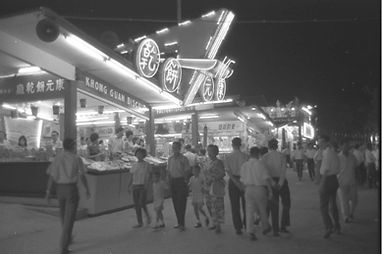
A typical night at the Great World Amusement Park, 1962.
Source: National Archives of Singapore
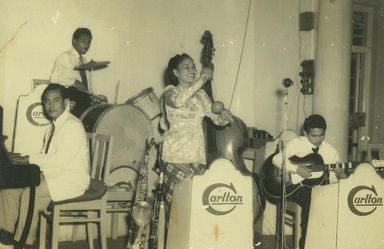
Nights were filled with the sound of cha-cha, rumba, joget and ronggeng at Bunga Tanjong, a Malay dance hall in New World Amusement Park. The singer Momo Latiff is photographed performing here in the 1950s.
THE CITY BY NIGHT
In many of these songs, Singapore gleams. The first building in Singapore to be lit by electric lighting was Istana Tyersall, the palatial residence of Sultan Abu Bakar of Johor, in 1892 [iv]. By 1906, the first electric street lamps were installed [v]. Naturally, the illumination of streets and buildings after dark thus enabled the creation of a nightlife. None of this was lost on the song-writers. The city Abdul Rahman sings of is fully nocturnal:
Bila hari sudah malam, bintang-bintang mulai terbit
Singapura bandaraya cantik
Itu waktu rakyatnya melepaskan lelahnya,
Untuk bersiar di tepi pantai
When day turns to night, and the stars come out
Singapore’s a beautiful city
That’s when its people let go of their weariness
And have a stroll along the beach
Arguably, the song that memorialises Singapore’s scenic nightlife most explicitly is Saloma’s Singapura Waktu Malam (Singapore by Night). The city’s fluorescence is a sight to behold:
Singapura waktu malam, lampu neon indah berkilauan
Gedung tinggi gemerlapan, sungguh megah tiada bandingan
Singapore at night, its neon lights gleaming beautifully
Soaring buildings radiant, how grand beyond compare
Oh Singapura exhorts listeners to contemplate the bright lights enhancing the city’s splendour:
Indahnya Singapura, nama masyhur di seluruh dunia
Lihatlah bila malam — cahaya terang serta berwarna-warni
Kota ramai aman jaya serta terpuji antero tanah Asia
Bangunan sayup tinggi, tambah indah, oh Singapura City!
How beautiful is Singapore, its name renowned across the world
See it at night, brightly aglow and colourful
A city crowded, serene, triumphant and praiseworthy throughout all of Asia
Its buildings soaring high add to its splendour, oh Singapura City!
Beyond just illumination and seaside recreation, Singapore’s denizens also indulged in the myriad commercial entertainments the evening offered. Kalau Ke Singapura names three famous amusement parks that drew consistently large crowds between the 1920s and 60s: Happy World, New World and Great World. The song records them as places for “modern dances” (joget moden) and memories unforgettable. In fact, the amusement parks featured a plethora of entertainments, such as Chinese and Malay opera, cinemas, cabarets, dance-halls and boxing matches. Uncle Murtabak recalls how it was like to be at New World in Japanese-occupied Singapore:
Malam-malam di Shonan-to*
Masuk New World main lotto
Kalau menang memang […]**
Kalau kalah kena ketuk!
Nights in Shonan-to*
Go to New World and play lotto
If you win, it’s definitely […]**
If you lose, you’ll be knocked!
*Singapore was renamed Shonan-to (light of the Showa Emperor) under Japanese rule
**indiscernible
Gambling in these amusement parks was banned after the war.
By the latter half of the 20th century, the parks saw rapidly declining patronage, as ever-more ‘modern’ diversions grew popular. The last of these - Happy World - was demolished in 2001.
The city is also a literary site. Singapore was not just a pleasure-ground or a feast for the visual senses. As a motif, it had long featured prominently in the repertoire of classical Malay epics dating back centuries. Singapura Waktu Malam alludes to an episode from the 17th-century royal chronicle, Sejarah Melayu (The Malay Annals). It is a gruesome story known to most contemporary Singaporeans: a king of ancient Singapura - then already a wealthy port-city - puts an end to attacks on the island by garfish, after a child comes up with an ingenious solution. Threatened by his intelligence, the king orders his execution:
Sejak dulu dah tersurat
Singapura tak kurang kisahnya
Antara yang paling dahsyat
ikan todak melanggar Singapura
Since days of old it has been written
Singapore has never been short on stories
Among the most terrible:
That of the garfish invading Singapura
The city is not just to be narrativised; it is itself replete with narrative. It compels one to tell stories. Some of these songs resemble travel accounts to foreigners who had never visited. Others - like Uncle Murtabak - relate everyday incidents of life in the city: stories we tell each other as we collectively navigate urbanity’s absurdities. Such a profusion of stories of and about Singapore ought to make us resist attempts to typify it according to widely-assumed stereotypes, or rehearsed official histories.
POPULAR MUSIC AS LOST ARCHIVE
Singapore marks its separation from Malaysia annually on ‘National Day’. We sing our city differently now. The Singapore government has commissioned a new patriotic song for National Day every year since 1984, all variations on a set of themes, such as national belonging and progress. They reflect the ideological imperatives of their time. In Singapore’s national narrative, today’s gleaming skyscrapers and bubblegum-coloured high-rise flats are pitted against the squalor and filth of its expunged kampong. In the same year Seniman Bujang Lapok was released, a great fire broke out in the district of Bukit Ho Swee in western Singapore. 16,000 were left homeless, after their largely wooden homes were destroyed. Scholar Loh Kah Seng argues that “in the Singapore Story, the fire is depicted as a ‘blessing in disguise’, whereby an enlightened government rehoused the ‘inert community’ of squatters after a disaster and set the country on the right path to progress and modernity.” [vi] Singapore’s modernisation plot has been reduced to a battle between the flat and the kampong, where the former finally triumphs.
But as these songs show, even before Singapore exemplified characteristics of the well-planned city, it was already a celebrated centre of urban sophistication. These songs reflect an efflorescence of modernity that its many residents - ordinary men and women - actively participated in, built and sustained. The formal elements of these songs also embodied the cosmpolitan milieu inhabited by their composers and performers. They each represent a genre with origins elsewhere, which nonetheless assimilated seamlessly into Singapore’s musical landscape. Afro-Cuban rhythms, jazz, keroncong, and foxtrot found their way into the scores of great Malay composers like Ahmad Jaafar and Zubir Said (who would later go on to compose Singapore’s National Anthem).
The historical moment they resurrect - an era when Singapore was still thought of as being part of Malaya - holds great significance to the city’s Malays. As the playwright Alfian Sa’at notes, this was also the golden age for the Singapore Malays not just due to their cultural achievements but their “integration to a wider Peninsular community” [vii]. They expressed optimism for a modernity that looked quite different from the one Singapore eventually came to represent. Separation from Malaysia was a moment of trauma, entailing the Malays’ cultural orphaning, and what Alfian termed “the disintegration of the Malay cultural psyche”[viii].
These songs are rarely aired today, and few Singaporeans now know they exist. Discovering this lost archive, however, enables us to realise that Singapore inhabited an array of historical imaginaries from competing discourses, beyond the one we are most familiar with now. It was also - like many other cities - the product of multiple visions of modernity, and its uncelebrated multitude of agents.
But as these songs show, even before Singapore exemplified characteristics of the well-planned city, it was already a celebrated centre of urban sophistication.

Malaya: Ramlee and Saloma sing popular music of the East, an LP recorded in the 1960s as part of Capitol Records’ “Capitol of the World” series, which sampled music from different countries. The ‘Malaya’ album featured P. Ramlee and Saloma, with a street in Singapore’s Chinatown as its cover art.
Source: Discogs
Notes
[i] “Modern Singapore – the City of Opportunity: IX. How Singapore Goes to Work”. Malaya Tribune. 7 April 1933. p. 15.
[ii] Imran Bin Tajudeen. “Beyond Racialised Representation: Architectural Linguae Francae and Urban Histories in Kampong Houses and Shophouses of Melaka and Singapore” in Rajagopalan and Desai, Colonial Frames, Nationalist Histories: Imperial Legacies, Architecture and Modernity. Ashgate, 2013. pp. 213-252.
[iii] Ibid.
[iv] “The Sultan of Johor’s Singapore Residence”. Straits Times Weekly Issue. 6 December 1892. p. 19.
[v] Nor Afidah Abdul Rahman. “Street Lighting”. Infopedia.
[vi] Loh Kah Seng. Squatters into Citizens: the 1961 Bukit Ho Swee Fire and the Making of Modern Singapore. Singapore: NUS Press, 2013.
[vii] Alfian Bin Sa’at. “The Absent Mother: Malay Cinema, Cultural Memory and Mediated Spectatorship” in S/pores: New Directions in Singapore Studies, Issue 14 (“Yang Tersirat”). 22 July 2015. http://s-pores.com/category/14-yang-tersirat/
[viii] Ibid.

About the Author:
Faris Joraimi is an undergraduate at Yale-NUS College in Singapore. An enthusiast of classical Malay literature, material culture and history, he has written for a number of platforms, including S/pores, Mynah magazine, New Naratif, Karyawan, Coretan, Passage and Budi Kritik. He has also co-curated two public talks with Singaporean playwright Alfian Sa’at, and is currently editing a history of Singaporean Malay gastronomy.